NutriFibre: The choice of an Austrian dairy farmer
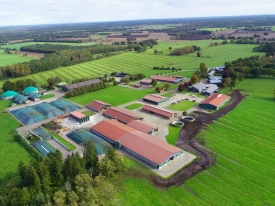
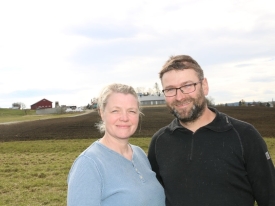
In the transitional zone between arable land and permanent grassland, at around 500 meters above sea level near the idyllic Attersee in Upper Austria, innovative dairy farmer Erich Oberndorfer runs his family farm with great care and a strong focus on sustainable feed. Since 2015, he has relied on the Vital* grass mixture with NutriFibre technology – a strategic decision that has paid off for both him and his animals.
Why NutriFibre?
In the past, Erich Oberndorfer used an intensive grass mixture suitable for harsh climates from the local supply store. However, this mix, dominated by orchard grass, became “too quickly overgrown.” On the recommendation of his local contact at Schaumann – Barenbrug’s distribution partner – he tried Vital*.
“If the soil is well fertilised, you can achieve a correspondingly high yield,” says Oberndorfer. “This mixture is productive and stays fresh for a long time.” He was convinced – and since then, NutriFibre has become a fixed part of his forage system.
Oberndorfer is convinced that in times of increasing weather extremes and rising feed costs, sustainable milk production depends on stable, high-quality forage – ideally from one’s own land. That’s why he chose a mixture that combines yield, structure, and persistency.
More than just feed
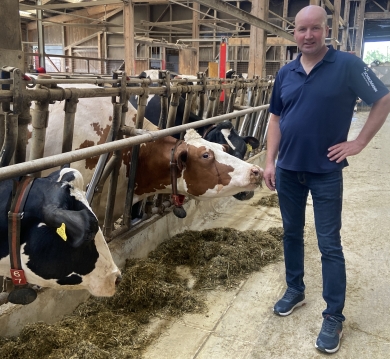
NutriFibre technology, developed through decades of breeding by Barenbrug, is based on soft-leaf tall fescue. This grass species develops a deep root system, which provides excellent drought resistance, stable yields, and good forage quality. On his farm, the mixture is grown on 7 hectares of nearby fields, supplemented by 3 hectares of permanent grassland. These 10 hectares supply feed for his 60 Holstein-Friesian dairy cows, each producing an average of around 12,500 kg of milk annually.
“I harvest seven cuts a year for the cows – the first at the end of April, the last in early October,” Oberndorfer explains. “The feed is staggered – the first five cuts go to the cows, the later ones with longer intervals are for the young stock.” The farm does not use grazing; instead, silage is used exclusively.
Silage maize and NutriFibre: a strong combination
His feed ration consists of about 65% maize silage, supplemented with NutriFibre silage. The farm manages 70 hectares in total: 17 ha maize, 9 ha soybeans, 12 ha malting barley, 12 ha wheat, plus permanent pastures and grassland with tall fescue. The NutriFibre fields are fertilised with mineral nitrogen and receive slurry two to three times per year. Crucial for Oberndorfer is the use of trailing hose systems for low-emission slurry application, a standard practice on the farm since 2021.
Long-lasting performance without reseeding
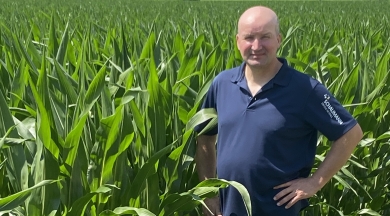
Reseeding is not necessary with NutriFibre. “I sow 50 kg per hectare – more than recommended, but it creates an extremely dense sward,” the farmer explains. The robust root system and frequent cutting prevent gaps and unwanted species from establishing. “If you cut often, you don’t need to reseed – that’s how it works for me.”
The sward is not only high-yielding but also long-lasting – and copes with hot summers much better than typical permanent pastures in the region. “The feed stays fresh, even when everything else has long dried up,” says Oberndorfer.
Feed quality that delivers
In terms of nutritional value, the NutriFibre mixture consistently delivers strong results: crude fibre levels of 22–25%, crude protein between 18–22%, and an energy content of 6.5 to 7 MJ NEL/kg dry matter. “If your basic forage is good, there’s no need to overdo it with concentrates,” Oberndorfer emphasises. “Only with good forage can you achieve high milk yields.”
Fresh matter yield is between 8 and 10 tonnes per cut and per hectare – a remarkable figure that, combined with the high number of cuts, results in an enormous total yield. For Oberndorfer, this means homegrown feed, with predictable effort and reliable quality.
Valuable advice from Barenbrug
In spring, the farm was visited by a Barenbrug advisor. “It was a good exchange of information,” says the farmer. “I shared how I work, and they gave me advice.” One tip proved particularly useful: after snow mould damage in spring, removing the dead grass with a swather helped restore the sward quickly.
A strong local partner
A close relationship with distributor Schaumann has also been a key success factor. “I have a good contact with Schaumann's representative. We know each other well, and he recommended the mixture to me.” In addition to the Vital* mixture, the farm also sources silage additives from Schaumann. The partnership is practical, personal, and built on mutual trust.
A Dairy Farmer Who Thinks Long-Term
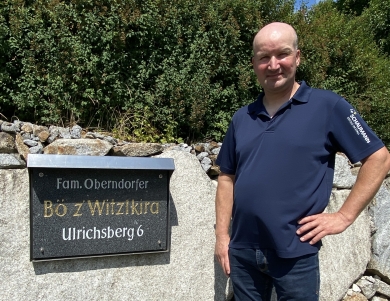
At 46 years old, father of two daughters, Oberndorfer runs the family farm together with his family. The farm operates conventionally and is equipped with modern technology, including a milking robot and advanced feed mixing equipment. While his wife primarily manages the barn, Oberndorfer is responsible for the fields. Harvesting is done in half-day shifts, and silage is precisely planned and organised – with clear separation by feed types and qualities. “We mix for two months in advance and always have just one silo open – it’s efficient.”
*In Austria, we sell Vital under the name GreenStar Struktur II.
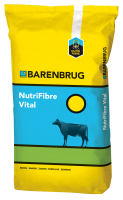
Vital
-
Special mixture based on the NutriFibre® technology
-
Massive forage, energy and protein for more milk
-
Rich in effective fibre for healthy cattle