
Year-Round Playability: The Secret Behind Heelsum Golf Club
For Head Greenkeeper Jeroen Brouwer de Koning, year-round playability has long been the foundation of his course management philosophy. Since 2013, he has been responsible for maintaining Golfbaan Heelsum, a course renowned for its natural character, challenging design, and exceptional playing conditions.
Even during wet winter periods, Heelsum remains accessible to golfers, including those using buggies. Maintaining this level of quality, however, requires constant forward thinking. Climate change, prolonged drought, stricter regulations, and rising operational costs demand smart management decisions, not only for today, but also with the future in mind.
Maximum Playability Through Efficient Management
When speaking with Jeroen Brouwer de Koning, it quickly becomes clear that good course management is all about balance. A balance between playing quality, available labour hours, water consumption, and budget.
"I have to look at my available hours and budget and try to achieve the best possible result."
This approach is reflected in almost every management decision made at Heelsum. For example, the tees are mown only once a week. At many golf courses, this is done two or even three times a week, but according to Brouwer de Koning, that does not fit Heelsum’s management philosophy.
The choice of slower-growing grass varieties makes it possible to maintain high playing quality with fewer mowing operations. The time saved can then be invested in the areas of the course where maintenance has the greatest impact, such as the greens.
"I would rather spend that time on the greens. That’s where you ultimately make the difference."
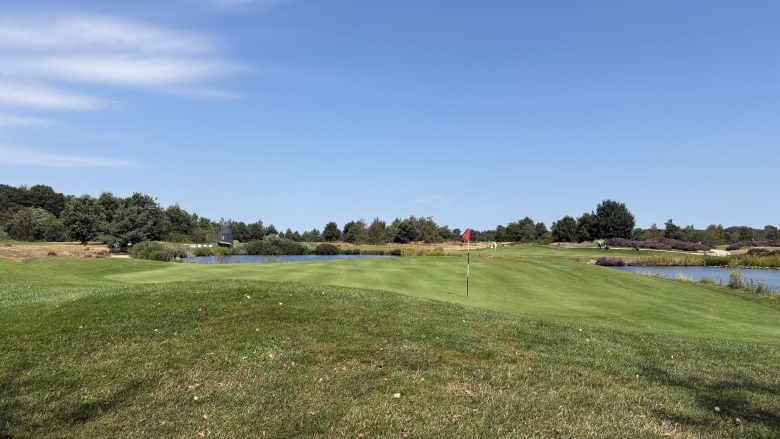
Why Brouwer de Koning Chooses Red Fescue
A key factor behind this approach is the choice of BarFescue Plus, a carefully formulated blend of red fescue and hard fescue varieties. Throughout different areas of the course, Brouwer de Koning deliberately selects these grass species because of their strong performance characteristics.
Red fescue is slow-growing, requires less water, and needs fewer nutrients than many other turfgrass species. Hard fescue is exceptionally drought tolerant. Together, these characteristics make it possible to reduce maintenance intensity and inputs without compromising playing quality.
If we switch to faster-growing species such as perennial ryegrass, we need to mow more frequently. One mowing round per week is no longer sufficient.
The choice of BarFescue Plus is therefore not just a grass selection, but also a management decision. It enables the greenkeeping team to maintain a high standard of quality while working with limited resources.
Learning from Experience on the Greens
On the greens, Brouwer de Koning has deliberately taken a different approach from that of many other golf courses. Several years ago, Heelsum chose a mixture that also included bentgrass, as it is easy and quick to overseed.
However, that decision was put to the test when the course experienced take-all patch, a turf disease associated with the high pH level of the groundwater. The bentgrass proved to be highly susceptible to the disease, while the red fescue remained far more resilient.
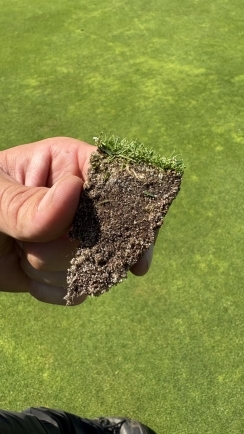
We saw that the red fescue performed much better under these conditions. That makes you question which option is truly the best choice for the long term.
Since then, a stronger focus has once again been placed on red fescue. To achieve this, BarFescue Plus is used, a blend that combines different fescue species. According to Brouwer de Koning, it is precisely this combination that creates greater resilience.
"I believe in a mixture of species. That way, you spread the risk when disease pressure or extreme weather conditions occur."
In addition to drought tolerance, disease resistance also plays an important role. The different components of BarFescue Plus have been selected for their resistance to diseases such as dollar spot, one of the most significant turfgrass diseases facing greenkeepers today.
Overseeding Keeps the Course in Top Condition
Brouwer de Koning keeps the greens in top condition through regular overseeding using the Plant Pot method. The process starts by creating holes of 2 to 3 cm in the turf using an aeration machine.
"We spread the grass seed with a fertiliser spreader and then apply sand across the green. Once the sand has dried, we brush it into the holes using a driving range mat. This helps us maintain a dense green sward while keeping the soil stable and free-draining."
Applying Water Where It’s Needed Most
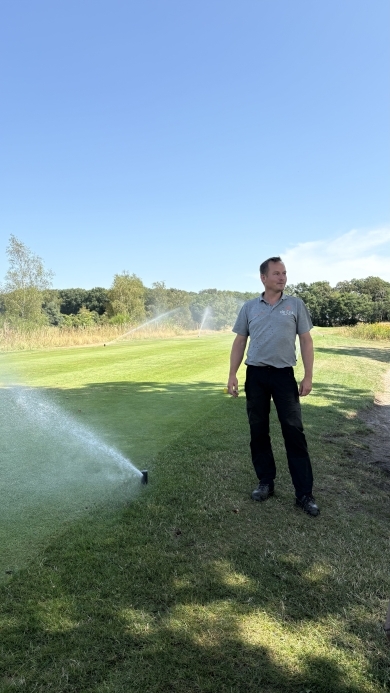
Perhaps the most important challenge for the future is water management. In recent years, Golfbaan Heelsum has therefore invested heavily in a modernised irrigation system.
Where large sections of the course were once irrigated simultaneously, the course now operates a system in which each individual sprinkler on the greens, surrounds and approaches can be controlled separately.
"We can now apply water much more precisely. Only where it’s needed."
This not only results in better turf quality but also prevents unnecessary water consumption. For Brouwer de Koning, this is essential, as he expects water availability to come under increasing pressure in the years ahead.
The choice of drought-tolerant grass species also plays an important role in this strategy. In particular, he sees the hard fescue component within BarFescue Plus as a valuable development.
Hard fescue uses water and nutrients even more efficiently and performs exceptionally well under dry conditions.
A Course That Works with Nature
Sustainability has been a key focus at Golfbaan Heelsum for many years. The course committee has deliberately chosen to allow the fairways to reflect the changing seasons. As a result, fairways do not need to be intensively irrigated to remain green during dry periods.
According to Brouwer de Koning, this is not a sign of neglected maintenance, but a conscious choice that fits within a sustainable course management strategy.
"Fairways don't have to be bright green all year round here. They can change with the seasons."
By using less water and fewer fertilisers where conditions allow, the environmental impact is reduced without compromising the playing experience.
The same philosophy applies to plant protection. For many years, the course has focused on minimising the use of chemical products. Where possible, biological solutions are used, and new technologies are closely monitored, such as spot spraying, where only problem areas are treated. Winter diseases such as Fusarium and Microdochium are not treated, as the red fescue performs well and naturally withstands these diseases.
Preparing for a Future with Less Water
Although the course currently benefits from a modern irrigation system, Brouwer de Koning is already looking ahead. He expects restrictions on groundwater use to become increasingly stringent in the future.
To prepare for this, the golf club is exploring ways to further strengthen its water management strategy. One option under consideration is the construction of a water reservoir to capture and store rainwater for use during dry periods.
We've already experienced restrictions on daytime irrigation. I expect water to become an even more important issue in the future.
For Brouwer de Koning, this is not a cause for concern, but rather a clear challenge to address. By investing in efficient water use, drought-tolerant and disease-resistant turfgrass varieties, and smart management practices, he aims to ensure that Golfbaan Heelsum retains its greatest strength well into the future: providing outstanding year-round playability on a sandy soil course.
Our Advice for Golf Courses

RPR® Golf Dense
-
Highest sod density
-
Mowing height possible from 5 mm
-
Less damage due to regenerating ability
RPR® Golf Extreme
-
Highest wear tolerance
-
Regenerating ability due to RPR-grass technology
-
Fastest establishment
Resilient Blue® Golf
-
Tolerance during stress periods
-
Fastest recovery after stressful periods
-
Extraordinary wear tolerance

Bar Fescue Plus
-
Close mowing tolerance down to 5 mm
-
Whole year green
-
Less fertiliser required