
New grass concept gives grassland a protein boost
Newly established grassland needs time to reach its full production potential. As a result, the first cut often falls short of expectations. A new grass concept combining annual and perennial clovers significantly shortens the establishment phase.
Dairy farmer Richard Blenke and his son Roy from Hertme are achieving good results with the new grass concept. Shortly after the maize harvest, they sowed the field with a combination of Topsilo (tetraploid perennial ryegrass), Duet (perennial white clover and red clover) and Protafix (a mixture of four annual clovers). According to Richard Blenke, this already resulted in three productive, protein-rich cuts in spring.
It is a beautiful, fresh crop with very good yields, especially for a newly established field.
The farmer harvested the first cut of this crop on 28 April and the second cut on 28 May. The third harvest took place at the end of June.
Greater need for clover in spring
Product Manager Tom Niehof elaborates on the innovative grass concept. “Dairy farmers are looking for more clover in spring. Not only to achieve higher yields, but also to increase protein levels and reduce sugar content somewhat in the first and second cuts. Red or white clover alone cannot deliver this, as they only really get going later in the year.” Niehof explains that this is why they have had positive experiences with adding annual clovers when establishing a permanent grassland mixture. “Dairy farmers in France and Belgium already have much more experience with this.” It is particularly during the first six months after establishing new grassland that this provides a tremendous boost to both production and quality, resulting in significantly more clover in the first cuts. An indirect benefit, according to Niehof, is that it also helps reduce the use of mineral fertiliser. “Because the clovers are already clearly visible.
Development of the clover proportion in the first year after establishment
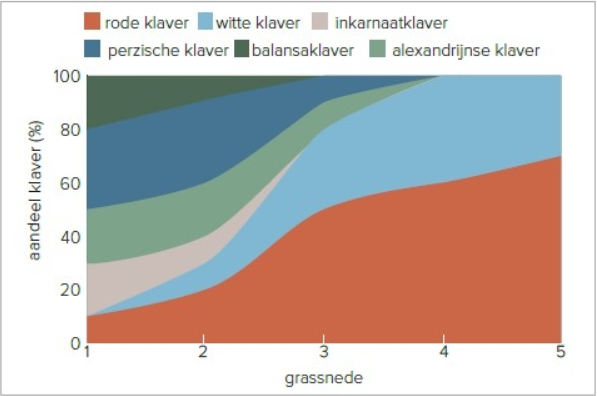
Contribution of different clover species
Each of the four annual clover species in the mixture has specific characteristics that contribute to this unique grass concept:
Balansa Clover is known for its high productivity under cooler or wetter conditions, making it particularly suitable for the winter period. Another major advantage of this clover is its ability to maintain feed value. Most other clovers lose digestibility once they start flowering, whereas Balansa clover does not.
Persian Clover is particularly well suited to dry conditions.
Alexandrian Clover is a highly productive clover, while
Crimson Clover is a true all-round crop that performs well on all soil types.
Niehof describes the combination of annual clovers with the perennial, conventional white and red clovers as combining the best characteristics of a 100-metre sprinter with those of a marathon runner.
This gives the marathon runner an impressive start.
An experiment worth repeating
At the Blenke family farm, the slurry application before the first cut was omitted entirely. “The grass was developing so well that additional slurry was not necessary,” says the dairy farmer. Grass production plays a key role on the farm. The more than 200 dairy cows are housed indoors and achieve an average production of 11,300 kg of milk with 4.36% fat and 3.58% protein. Blenke aims for protein-rich first cuts with good yields and also makes extensive use of summer stall-feeding. Blenke has several years of experience with mixtures of white and red clover, but working with the addition of annual clovers was new to him. “Due to changing regulations regarding rest crops, I was looking for more temporary grassland and greater flexibility while maintaining quality. That objective has been achieved. I will certainly repeat this experiment after this year’s maize harvest,” he says. The annual clovers disappear after the first year. Is that not a disadvantage? Niehof: “In practice, the perennial white and red clovers then take over production. As a result, this mixture is particularly interesting as a boost for the first cuts following the establishment of new grassland.”
Experience of a Belgian dairy farmer
One of the Flemish dairy farmers growing annual clovers is Frank De Cock. Together with his son Arjen in Sint-Laureins, he runs a dairy farm with 400 dairy cows. In the third week of September 2025, following the maize harvest, De Cock established a unique grass-clover mixture on 15 hectares. The mixture consists of tetraploid perennial ryegrass and hybrid ryegrass, along with four clover species: two perennial clovers, white and red clover, and two annual species, crimson clover and Balansa clover. In Belgium, the use of clovers in combination with perennial ryegrass has clearly increased over the past three years. The government provides attractive subsidies for the cultivation of legumes. The two annual clovers also gave the newly established grassland a flying start on his farm. As early as 20 April, De Cock harvested a first cut yielding more than 3 tonnes of dry matter. The second cut was harvested on 20 May and produced approximately 2.5 tonnes of dry matter. The third cut was harvested around 20 June and yielded another 2.5 tonnes of dry matter of grass-clover. This year, De Cock hopes to harvest at least seven cuts from the crop. “We operate an intensive dairy farm with a high-producing herd on humus-rich sandy soil, with a ration consisting of 75 percent maize and 25 percent grass. Our aim is to maximise the amount of high-quality forage produced on the farm, and this highly productive mixture fits very well within that objective in combination with crop rotation.
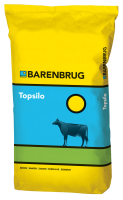
Topsilo
-
High-performance forage for top-yielding dairy cows
-
Fast and efficient ensiling thanks to high natural sugar content
-
Enriched with red and white clover to boost protein levels
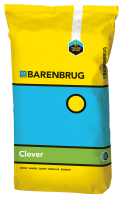
Duet
-
Guaranteed success with Yellow Jacket Nitrogenerator®
-
Ideal in combination with little fertilisation
-
Fertile soil
ProtaFix
-
Balansa clover, a species known for its high production, especially in wet conditions (autumn/winter) combined with outstanding feed value
-
Persian clover, especially suitable for dry conditions and known for its ability as the best clover to fix nitrogen
-
Berseem clover, a productive clover that increases the success of spring sowing