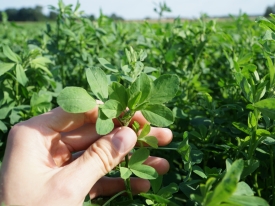
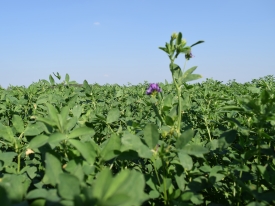
'Lucerne is an ideal structural fibre source with a high protein content'
Cultivation is increasingly well‑suited to the Dutch climate
On the Ten Vorsel Estate in Bladel, the Geenen family keeps 130 dairy cows and runs a care farm. The daily management of the herd is in the hands of farm manager Raoul Frenken. Because of the large land base (85 hectares) and the estate’s special status, the farm follows a cropping plan in which lucerne plays a dedicated role.
The driveway through the beech-lined avenue immediately reveals the distinctive landscape around the farm. To the right of the lane lies a high, convex field, and to the left the pasture slopes down toward the Aa river. ‘This elevated 4‑hectare field is very suitable for lucerne cultivation,’ says Raoul. Lucerne does not tolerate low, wet soils, as these can hinder root growth. ‘Light sandy and clay soils are perfect for the crop. The root can grow deep into the soil to access water and nutrients.’
This year marks the fourth consecutive year of lucerne on the convex field. Because of the exceptional weather, 2026 is a very good growing year. Lucerne thrives in warmth and dryness. ‘We have already harvested four good cuts, and the fifth will be harvested in October,’ Raoul says. A successful crop starts with the right sowing strategy. Proper liming is recommended. ‘A pH of around 6 is best. Then early development is optimal and the root immediately grows deep.’
Sowing with crimson clover
August and early September are the most ideal times for sowing because soil temperatures are high. Spring sowing is also possible, provided the soil temperature is above 10 degrees Celsius. To reduce weed pressure after sowing, Raoul sowed crimson clover together with the lucerne . This annual clover emerges quickly and prevents weeds from growing. After the first cut, only about 20 percent of the clover remains. The following year, the crimson clover has disappeared.
Fertilizing lucerne is simple. In February, the farm manager applies 10 tonnes of farmyard manure to supply phosphorus. In March, he spreads a potassium fertilizer over the land. He uses a by‑product from citric acid production. Besides potassium, it also contains a lot of magnesium and sulfur for protein formation. Around the third cut, he applies 100 kilos of Potassium 60 per hectare. ‘As a legume, lucerne does not need nitrogen fertilization, but the crop consumes a lot of potassium. With multiple potassium applications per season, you achieve the highest yield.’
September is a rest month
From May through October, lucerne can be mown every month. But Raoul skips September. The crop then gets rest to direct energy to the roots for good winter dormancy and emergence in spring. In October, the fifth and final harvest of the year takes place. ‘With lucerne , you have to think differently than with grass. If you do that well, it’s a beautiful crop.’ Thinking differently also means not mowing too short. ‘I mow at 10 centimeters. That way you don’t damage the young shoots at the base of the stem, and four weeks later you can harvest enough again.’
With lucerne you have to think differently than with grass. If you do that well, it is a beautiful crop.
Raoul Frenken - Landgoed Ten Vorsel
Lucerne does not tolerate trampling and mechanical disturbance. For that reason, crimping lucerne during mowing is out of the question. Raoul does not use the conditioner, but he does let the crop pass over it during mowing so that it is laid out wide across the field and can be raked the next day. ‘I rake at a relatively high speed and low rpm so that the crop is touched as little as possible and the protein‑rich leaves remain attached to the stem.’
Headlands of grass
Because Raoul uses lucerne as a protein‑rich structural forage instead of straw, the harvested crop is pressed into large bales. ‘I only feed 0.5 to 1 kilograms of lucerne dry matter per cow per day. That is not much. That’s why bales are ideal.’ He does recommend wrapping the bales extra well. ‘The stems can sometimes poke through the film. You need to prevent that.’ For the ideal product, he has the contractor use all knives in the baler so that the alfalfa stems are no longer than 7 centimeters.
The farm manager describes lucerne as a minimalist crop. ‘Stay away from it as much as possible,’ he warns. ‘Drive through the field as little as possible, keep the slurry injector out, and make a smart field layout.’ Regarding this last point, Raoul chose to sow the headlands of the lucerne field with grass. ‘Here the tractors can turn without damaging the crop.’ He mows the grass at the same time as the lucerne or when he mows the adjacent grass fields. ‘I just see what works best.’
18.2% crude protein, NDF 385
What Raoul appreciates about lucerne is its drought tolerance, feed value, and palatability. This year’s harvest contains 18.2 percent crude protein and an NDF of 385. It is therefore a protein‑rich structural fibre source. That cows find lucerne palatable is something he experiences every day: ‘If they don’t eat the lucerne , call the vet, because then something is wrong.’ Besides lucerne , the ration consists of grass/grass silage, maize, and winter barley. The barley serves as a concentrate replacer and is ideal for crop rotation and as a rest crop. ‘After harvesting in July, you can still harvest two cuts of grass.’
When asked for which dairy farmers lucerne would be a suitable product, Raoul has a clear answer. ‘lucerne is especially interesting for farmers who grow feed in an arable‑style system or who collaborate with an arable farmer for the cultivation of rest or rotation crops. In addition, it is a great crop for more extensive livestock farmers who want to save on buying straw while still producing a lot of their own protein.
Alfa Comfort
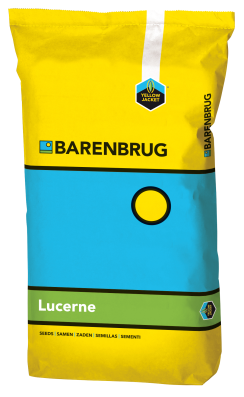
With Alfa Comfort, Barenbrug offers a mixture of two types of alfalfa: a Flemish type with high spring yields and a Mediterranean type that is more drought‑tolerant and performs particularly well in summer. This results in more stable growth throughout the season, suited to warmer and drier summers. For good establishment, alfalfa can be combined with 5 kg ProtaFix, an annual clover mixture that largely disappears after the first cut. A combination with 10 kg NutriFibre provides more sward formation and sugars, thereby improving ensilability.
More information about Alfa Comfort
Related articles
Alfa Comfort
-
Dormancy Class: 3-7
-
Long growing season
-
Harvest lucerne and grass at the same time