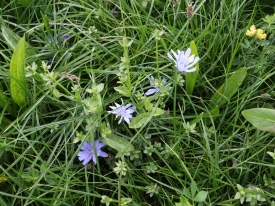
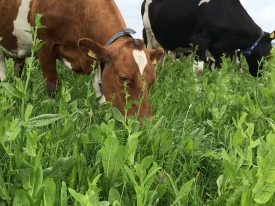
Cheese from a NutriHerb pasture at Corné Ansems' farm
Achieving 12.5 tonnes of dry matter per hectare with NutriHerb pastures
Corné Ansems and his sister Erica run De Ruurhoeve Cheese Farm in Hoogeloon, in the Dutch province of North Brabant. They have three years of experience with the NutriHerb grass and herb mixture. The diversity of plant species has proven highly beneficial, and for them, a grass-only sward is no longer an option. And the yield? At 12.5 tonnes of dry matter per hectare, it is more than impressive.
Benefits of herb-rich pastures
Cheese produced from herb-rich pastures is highly valued by cheese makers in Austria and Switzerland. Corné and Erica Ansems recognised the benefits as well: aromatic herbs can positively influence cheese flavour. They believed their Cholfitty cheese, the farm's flagship product enriched with omega-3 and omega-6 fatty acids, would benefit even further from the inclusion of forage herbs. The story of lush, diverse pastures where cows can graze from a wide variety of plants also resonates strongly with customers who enjoy visiting Hoogeloon to buy locally produced farmhouse cheese.
Starting with field margins
The Ansems family did not make the transition overnight. In the first year, they sowed only nine-metre-wide field margins with NutriHerb Balance. This allowed Corné and Erica to gain practical experience with the mixture. After one successful year, they decided to establish their entire 13-hectare home farm with herb-rich pastures. Coincidentally, this was during the exceptionally dry summer of 2018. “Despite the drought, the yield was better than expected,” says Corné. “Last year, we harvested 12.5 tonnes of dry matter per hectare of forage. We are extremely satisfied with that result.”
Despite the drought, the yield was better than expected. Last year, we harvested 12.5 tonnes of dry matter per hectare of forage. We are extremely satisfied with that result.
Corné Ansems - Co-owner, De Ruurhoeve Cheese Farm
Excellent feed value
In addition to grasses, NutriHerb Balance contains red clover, caraway, chicory, sainfoin and ribwort plantain. Some of these herbs develop roots reaching depths of up to 75 centimetres, making them highly resilient during dry periods. Corné is equally positive about the mixture's feed value: “Ribwort plantain, chicory and clover have an exceptionally high feed value of around 1,200 VEM. As a result, a NutriHerb pasture offers a feed value comparable to that of a perennial ryegrass sward.”
Improved protein utilisation
Each herb contributes specific benefits. The ribwort plantain variety bred by Barenbrug grows upright rather than spreading horizontally. It helps improve protein utilisation in the rumen while supporting a healthy soil ecosystem. Other herbs, such as chicory and sainfoin, can help reduce the impact of gastrointestinal worms, supporting better growth in young stock. At present, Corné applies 150 kg of calcium ammonium nitrate (CAN) in spring. However, his ambition is to replace this with farmyard manure and slurry in the future, working towards a system that relies entirely on organic fertilisers and avoids the use of chemical crop protection products.
A better balance
“For us, achieving the highest possible yield per square metre or hectare is not the main objective. Softer values, such as biodiversity, are equally important, both above and below ground.” Corné believes these values will become increasingly relevant for conventional dairy farms as well. “We are moving towards a better balance between all the processes on the farm.”
Related articles
NutriHerb Balance
-
Herb-rich grassland with preserved feed value and production
-
Excellent feed value and yield
-
Resilient to a changing climate