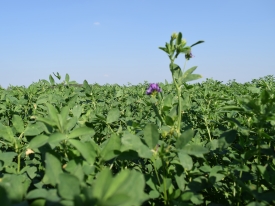
Excellent feed value

Effective fibre and protein with a high dry matter intake
Well-ensiled lucerne is very palatable to cattle and provides excellent rumen stimulation. The stems stimulate the rumen, improving digestion. The saliva produced by animals during rumination results in stabilisation of the rumen pH. The main advantage of lucerne is the fast digestion of the crop. The rumen remains full of feed without the risk of congestion. As a result, lucerne offers a lot of effective fibre and protein in combination with a high dry matter intake.
Nutritious forage for dairy cattle
Lucerne is also a highly nutritious forage for dairy cattle. It combines good digestibility with high protein. For dairy cattle, the most suitable feed type of lucerne is silage, whereas lucerne hay will be more suitable for feeding young stock or horses. Lucerne provides excellent milk yield despite the fact that lucerne silage has lower energy per kg dry matter compared to grass silage. However, farmers can enhance the feeding qualities of lucerne by cutting it earlier, just before flowering. This results in more energy and protein per kg dry matter.
| Harvest stage | Pre bloom | Early bloom | Mid bloom |
|---|---|---|---|
| Crude protein (%) | 21.1 | 18.9 | 14.7 |
| ADF (%) | 30.2 | 33.0 | 38.0 |
| NDF (%) | 40.5 | 42.0 | 52.5 |
| Dry matter intake (kg/day) | 14.2 | 13.7 | 13.3 |
In a diet lucerne brings protein and fibres (structure). Therefor it’s ideally combined with maize (for starch) and grasses (for sugars and digestible cell walls) as forage components. As an example, average quality of lucerne, maize and grass silage is shown below:
Lucerne silage | Maize silage | Grass silage | |
|---|---|---|---|
| Sugar (g/kg DM) | 20 | 15 | 80 |
| Starch (g/kg DM) | 0 | 320 | 0 |
| NDF (g/kg DM) | 400 | 370 | 440 |
| NDF-digestibility (%) | 58% | 55% | 75% |
| Crude protein (g/kg DM) | 210 | 80 | 170 |
| Energy for milk (VEM) | 800 | 950 | 930 |
| Dig. protein (DVE) | 55 | 58 | 75 |