Pennisetum clandestine - Kikuyu Grass
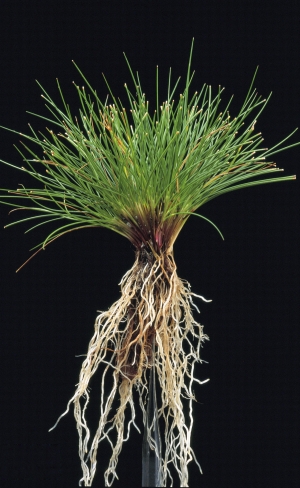
Kikuyu Grass is a warm season perennial lawn grass adapted to irrigated areas of the lower deserts in Arizona. It is a deep rooted, sod forming grass, spread by seed, rhizomes (underground runners), and stolens (above ground runners). It is a difficult species to produce seed and until recently it was unavailable in Arizona. Now with modern production techniques, seed is readily available from our Arizona seed grower. It is a drought tolerant grass that produces a dense turf with many advantages over bermudagrass lawns.
When compared to bermudagrass:
Kikuyu will stay green longer in the fall, and green up earlier in the spring. Like bermudagrass it will go dormant in the winter, but will remain active until temperatures go down to the mid 30’s F, while bermudagrass goes off color when temperatures are in the mid 40’s F. If soil moisture is maintained during the winter, Kikuyu can re-green during warm periods. In protected areas it has the ability to stay green year-round.
Kikuyu also maintains a very high degree of wear tolerance during its dormant period. While a bermudagrass turf breaks down rapidly after it goes dormant, leaving bare soils, Kikuyu will keep its integrity for a longer time, making the playing surface safer. In Australia it is preferred over bermudagrass for this reason.
Another big advantage of seeded Kikuyu Grass over seeded Bermudagrass is that people allergic to Bermudagrass do not seem to be bothered by Kikuyu Grass. Bermudagrass tends toproduce alot of pollen producing seed heads between mowing, while Kikuyu does notproduce many seed heads between mowing. Bermudagrass pollen (Like Olive pollen) tends to be an nasal irritant, while Kikuyu does not seem to have the same effect on people. While we cannot make the statement that Kikuyu grass is going to be pollen free and non-allergic to everybody, it certainly appears to be much less problematic than bermudagrass.
Kikuyu is courser than bermudagrass. It has runners similar in texture to St. Augustine grass. Unlike St. Augustine grass the leaves of Kikuyu grow up right, giving a nicer turf appearance. To maintain a healthy lawn, the mowing height Kikuyu should be between 1”- 2”, longer in the fall and winter. Like bermudagrass, Kikuyu will need an annual verticutting to maintain optimal appearance. Fertilize on a regular schedule during the growing season with a balance fertilizer.
Planting Rate:
Kikuyu grass should be planted in well prepared soils at the rate of 1 pound per 1,000 square feet.

Pennisetum clandestine - Kikuyu Grass